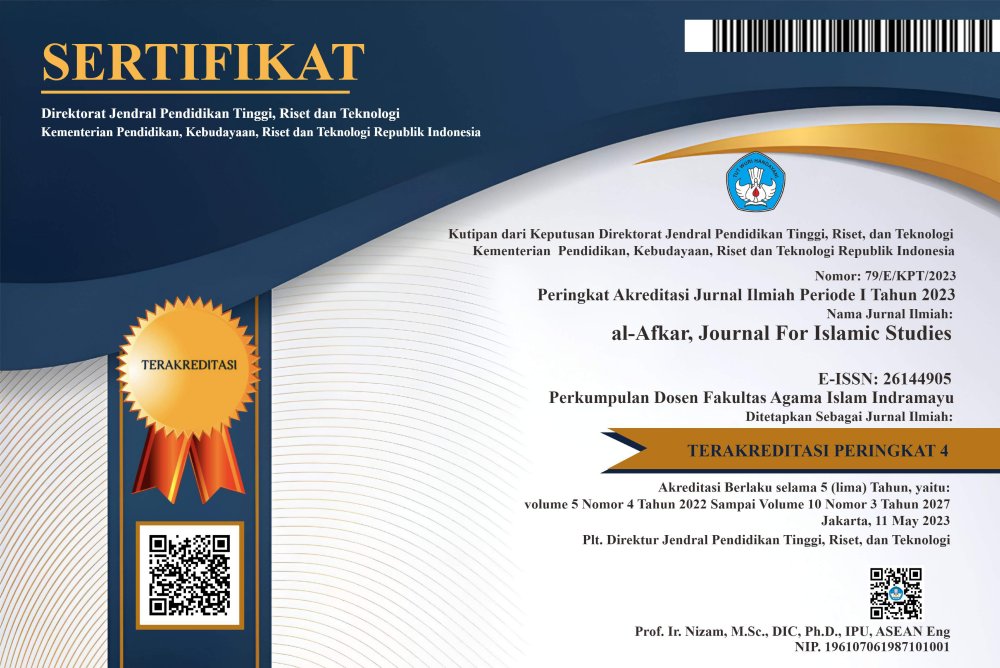
Internal Validity and Internal Validity Threats
DOI:
https://doi.org/10.31943/afkarjournal.v9i1.1922Keywords:
Internal Validity, Internal Validity ThreatsAbstract
A study is said to be valid if it has a proven causal relationship between its variables. A study is said to have validity if it can minimize various confounding factors that can affect the results and the level of trust in the study. Several threats to internal validity that can affect the results of the study The purpose of this study is to describe the role of internal validity in a scientific study and the threats to internal validity. The articles used as sources of literature review in this study are based on Google Scholar and PubMed data. The search for research literature uses the keywords "internal validity" and "threats to internal validity". The analysis technique used is the narrative method by grouping the data that was excavated. This study aims to describe internal validity and threats to internal validity in research. Threats to internal validity history, maturation, subject characteristics, mortality, location, subject attitude, instrumentation, testing, regression, implementation. Threat control techniques random assignment, blocking, matching, placebo, in addition to standardization of conditions, research subject information, detailed research information, and selection of appropriate designs internal validity ensures that research has a high level of trust and accuracy. Researchers must be confident that threats have been successfully controlled and their risks minimized so that they do not affect the research. Various techniques can be used to control threats to internal validity. Threats cannot be completely eliminated but can be anticipated and controlled.
Downloads
References
Brincks, A., Montag, S., Howe, G. W., Huang, S., Siddique, J., Ahn, S., Sandler, I. N., Pantin, H., & Brown, C. H. (2018). Addressing Methodologic Challenges and Minimizing Threats to Validity in Synthesizing Findings from Individual-Level Data Across Longitudinal Randomized Trials. Prevention Science, 19, 60–73. https://doi.org/10.1007/s11121-017-0769-1
De Young, K. P., & Bottera, A. R. (2018). A summary of reporting guidelines and evaluation domains for using single-case experimental designs and recommendations for the study of eating disorders. In International Journal of Eating Disorders (Vol. 51, Issue 7, pp. 617–628). https://doi.org/10.1002/eat.22887
Elsevier. (2014). Scopus: Content Coverage Guide. Amesterdam: Elsevier BV, 1–22.
Flannelly, K. J., Flannelly, L. T., & Jankowski, K. R. B. (2018). Threats to the internal validity of experimental and quasi-experimental research in healthcare. Journal of Health Care Chaplaincy, 24(3), 107–130. https://doi.org/10.1080/08854726.2017.1421019
Harzing, A. W. (2020). Everything you always wanted to know about research impact. In How to Get Published in the Best Management Journals: Second Edition (pp. 127–141). Edward Elgar Publishing. https://doi.org/10.4337/9781789902822.00016
Kurniadi, B. D. (2011). Praktek Penelitian Kualitatif: Pengalaman dari UGM. In B. D. Kurniadi (Ed.), Research Centre for Politics and Government (PolGov).
Laird, K. T., Smith, C. A., Hollon, S. D., & Walker, L. S. (2020). Validation of the Health-Related Felt Stigma and Concealment Questionnaire. Journal of Pediatric Psychology, 45(5), 509–520. https://doi.org/10.1093/jpepsy/jsaa030
Ledford, J. R., Barton, E. E., Severini, K. E., & Zimmerman, K. N. (2019). A primer on single-case research designs: Contemporary use and analysis. American Journal on Intellectual and Developmental Disabilities, 124(1), 35–56. https://doi.org/10.1352/1944-7558-124.1.35
Lonati, S., Quiroga, B. F., Zehnder, C., & Antonakis, J. (2018). On doing relevant and rigorous experiments: Review and recommendations. Journal of Operations Management, 64, 19–40. https://doi.org/10.1016/j.jom.2018.10.003
Orquin, J. L., & Holmqvist, K. (2018). Threats to the validity of eye-movement research in psychology. Behavior Research Methods, 50(4), 1645–1656. https://doi.org/10.3758/s13428-017-0998-z
Perianes-Rodriguez, A., Waltman, L., & van Eck, N. J. (2016). Constructing bibliometric networks: A comparison between full and fractional counting. Journal of Informetrics, 10(4), 1178–1195. https://doi.org/10.1016/j.joi.2016.10.006
Ronkainen, N. J., & Wiltshire, G. (2021). Rethinking validity in qualitative sport and exercise psychology research: a realist perspective. International Journal of Sport and Exercise Psychology, 19(1), 13–28. https://doi.org/10.1080/1612197X.2019.1637363
Slocum, T. A., Pinkelman, S. E., Joslyn, P. R., & Nichols, B. (2022). Threats to Internal Validity in Multiple-Baseline Design Variations. Perspectives on Behavior Science, 45(3), 619–638. https://doi.org/10.1007/s40614-022-00326-1
Stone, J. C., Glass, K., Clark, J., Munn, Z., Tugwell, P., & Doi, S. A. R. (2019). A unified framework for bias assessment in clinical research. International Journal of Evidence-Based Healthcare, 17(2), 106–120. https://doi.org/10.1097/XEB.0000000000000165
Sumberpengertian.Id. (2020). Pengertian Variabel Penelitian Menurut Para Ahli dan Umum Serta Jenisnya. In Https://Www.Sumberpengertian.Id/Pengertian-Variabel-Penelitian. April.
Valiente, D., Payá, L., Jiménez, L. M., Sebastián, J. M., & Reinoso, Ó. (2018). Visual information fusion through bayesian inference for adaptive probability-oriented feature matching. Sensors (Switzerland), 18(7). https://doi.org/10.3390/s18072041

Downloads
Published
How to Cite
Issue
Section
License
Copyright (c) 2025 Imas Siti Masuroh, Inda Dzil Mustaqim

This work is licensed under a Creative Commons Attribution 4.0 International License.